-
Alton MCM: Cherry Hill Apartments
Posted on March 7th, 2010 No commentsWashington Avenue
Alton, IllinoisIf you know where Fast Eddie’s Bon Air is on East Broadway in Alton, Illinois, simply take a left up Washington Avenue, and about a mile up the road is this lovely, 3-building apartment complex. It’s called Cherry Hill, and there is a good-sized mound to the east that may qualify as a hill, and maybe it did once have a cherry tree on it. Then again, development names are applied so randomly that it probably means nothing.
I’ve yet to find a way to look up Alton property information on-line (and if you know how, please do let me know), so am making a guess that this complex went up in the very early 1950s. There are quite a few other mid-century modern school and retail buildings along this stretch of Washington Avenue that went up from 1952 - 1960, so it may pre-date the earliest ones by a year or so.
As seen above, the entries to each building are whimsically modern, and the original doors with a nice harlequin pattern remain in place (although somewhat worse for wear).
The buildings themselves have a stately symmetry, and those wrap around corner windows would let in a generous helping of natural light. In the photo gallery of the apartment’s rental site, the view out those windows is pretty nice, and they have renovated the kitchens and bathrooms in an acceptable manner. The prices are really good, too.
As often as I pass by Cherry Hill, I never see anyone milling about, or coming and going, so it seems like a mild-mannered relic of low-key modernism. Very charming.
RELATED
Alton Mid-Century Bank -
See the Julius Shulman film January 30th
Posted on January 25th, 2010 2 commentsPost-Script, After The Event
Thank you to everyone who left their warm homes to spend time in Julius Shulman’s world. It was a an intelligent and enthusiastic crowd, and it was a true pleasure to personally meet so many of you. And Marlene Bricker is a joy! Here’s a few photos from the night.Most interesting bit of news from the night is that Shulman’s home is for sale! Within this link are some informative comments about the home, the realtor and its future prospects in a tear-down market. Even better, this link has extensive photos of the home cleaned up for selling. Looking at the shots of his studio made me tear up a bit - can you imagine living there?
Let’s hope the family makes sure the buyer is properly respectful. This is definitely a home worth preserving.
The Event
Visual Acoustics: The Modernism of Julius Shulman, a documentary by native St. Louisan Eric Bricker, makes a return engagement to the Moore Auditorium on the Webster University campus, January 29-31st, 2010. Here’s details about the film series and admission.
I’m asking you to come see this glorious documentary on Saturday, January 30th at 7:30 pm because I will be part of a Q & A panel after the film, and would love the support of sympathetic B.E.L.T. readers!
Yes, Marlene Bricker - mother of the director - asked me to be on the panel, which is so cool and sweet of her. But knowing that my adoration of Shulman could render me a blubbering gush of “wow,” I suggested that the best architectural photographer in St. Louis should also be on the panel, and luckily, Ken Konchel said yes!
So please do come out to see us this Saturday. Admission is $6, the film is 83 minutes long, and the 3 of us will take questions directly after.
Here’s my farewell tribute to Shulman, who passed away only last year.
And here’s my 2008 review of the film we’re lucky enough to see again!
-
Can Northwest Plaza Be Saved?
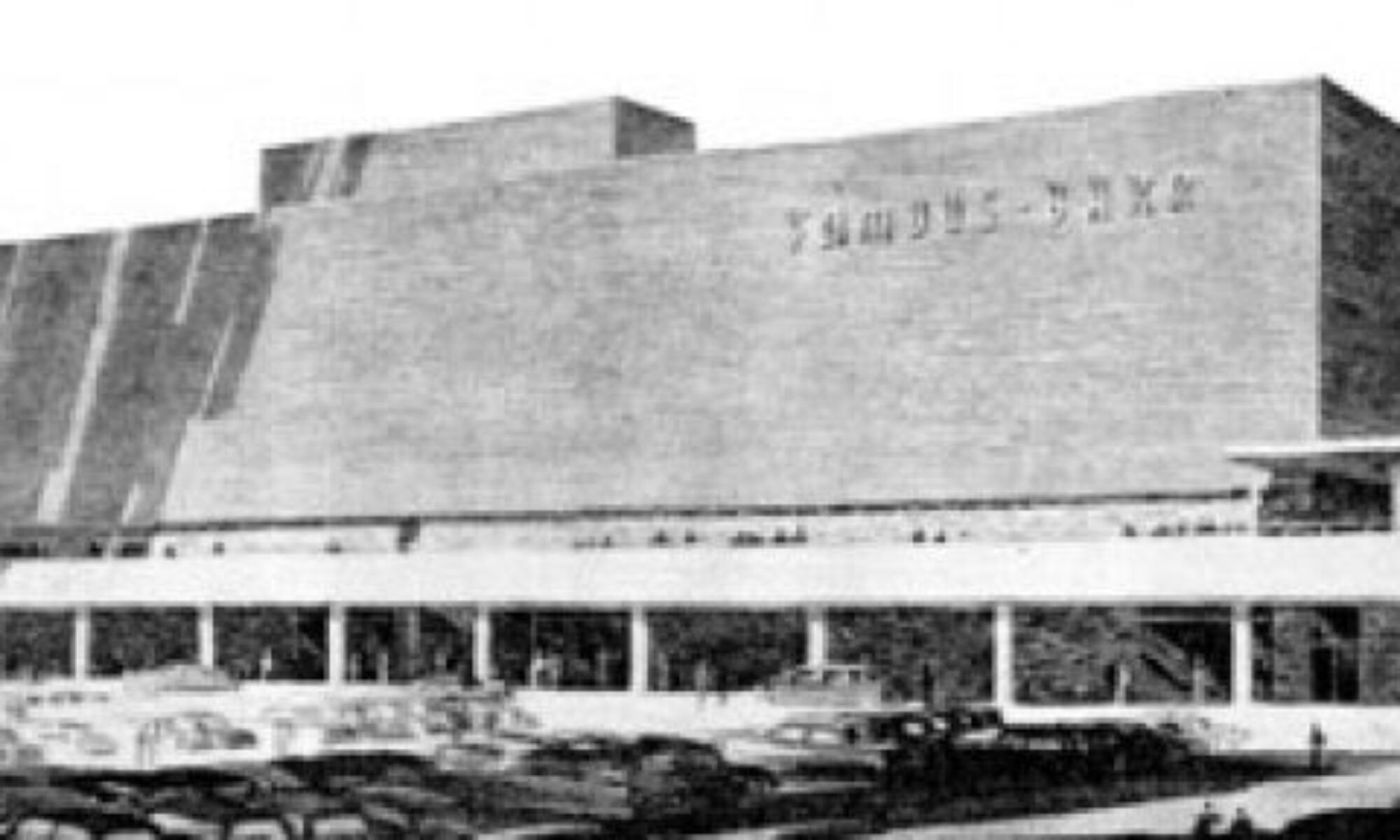
Posted on January 23rd, 2010 11 commentsThe news that Macy’s is closing its Northwest Plaza store marks the sound of the footsteps of a dead mall walking. The fate of both the former Famous-Barr department store and Northwest Plaza makes me ultra sad, and even before this news I was always nostalgic for the Northwest Plaza of old. It once had energy and personality, then someone decided to put a lid on it. It’s been a slow suffocation ever since.
My deep fondness for the Famous-Barr at Northwest Plaza stems from one exact moment in time, and it radiates out from there forever more.
November 1978, Olivia Newton-John releases the album Totally Hot. It was a calculated move to capitalize on her “bad Sandy” from Grease. The songs were the most rock she’d ever be, and it was matched with a look which was a modern-day continuation of the 1950s black leather look that had ended the movie my friend and I had seen 7 times in the movie theaters that summer. Some of the songs on this record were more guitar driven, the vocals randy and tough, and to a long-time Livvy fan (Nerd Alert: I belonged to her fan club years before Grease) it was revolutionary.
Just as important as the music (which still sounds just as great today, thanks to the brilliance of producer John Farrar) was the album cover art work. I had just turned 13, and had been given the go-ahead to wear make-up to school, and this is exactly how I wanted to look!
A Friday night in December 1978, I was dropped off at Northwest Plaza, and I trudged through the snow to get to the very spot shown above: the Estee Lauder counter at this Famous-Barr. Where else would a newborn teenage girl go to get that smokey-eyed Livvy look? I stared down through the glass case at all the eye liner pencils, and my heart pounded with excitement at this whole new world of possibility before me. Then a sales lady asked how she could help, and my head started pounding with fear because I had no clue what to say, what to do. I was only used to using the products in my Mother’s make-up drawer, not buying my own!
The sales lady was very kind, and after a swift transaction, I walked away with a fat Estee Lauder eye liner pencil of a deep blue-gray. It was my first make-up purchase, my first adult thing, and I still remember the smell of the winter air as I walked out of the store, and turning to look back inside at the warm glow of a cosmetics department that had accepted me as one of their own. Even then, I knew it was a milestone girl-to-woman moment.
As most teenage girls tend to do at the start, I too often left the house looking like a hussy raccoon. I abused that pencil something fierce, and still never came close to looking like Lovely Livvy. I do believe that the stub of that inaugural eye pencil still exists in one of my junk piles, holding onto it because that time resonated so deeply. And so does the place that it happened at.
Which is why I went there today, to take one last look around, take some photos, and see if the Ghosts of Shopping Past still float under that majestic, astro ceiling. Today was also a gathering of the Facebook groups I Hung Out at the Northwest Plaza Fountain as a Teenager and Let’s Revitalize Northwest Plaza Now! As a person still grieving from the death of Northland Shopping Center, I had to join both groups and then get a look at the people who were foolhardy enough to try and save a dying mall.
I was there around 1:30, so didn’t get to see what was eventually about 300 people, as reported by NOCO StL. But Northwest Plaza is so scary dead that seeing the healthy handfuls of people already gathered at the spot where the fountain once lay was heart-warming.
Putting a roof over this outdoor plaza was a bad idea from the start; back in the day, I don’t recall a single soul agreeing that this was just what the place needed. But this is what the then-owners felt was necessary to keep up with the Retail Joneses, that shoppers want a hermetically sealed environment more than they want personality and ease of access that comes from open-air malls. With millions of dollars of renovation, they erased the low-slung, mid-century midwest ease that changed with the seasons for a clinical, soulless, Any Town U.S.A. warehouse.
I have a sharp, instinctual sense of direction, but once they put the roof over Northwest Plaza, I got lost (as in “will this be an anxiety attack?” lost) every time. I’d try to use the anchor stores as place reminders of the old layout, but it was all so tall and bland and disconcerting, that I’d get discombobulated. The jagged contrast between what it used to be and what it had become was so depressing that I haven’t stepped foot in the place for well over 10 years. It had nothing to do with crime or location or the types of stores within. It was about being creeped out about walking over the burial grounds of a once-beloved place. Oh, how I long to see even the blurriest photo of those lighted deers that graced the Plaza at Christmas time… Northwest Plaza exists only in memories. This mall that has its name is just a tombstone.
I am so ecstatic to see a passionate group of people wanting to save this place that I can taste it, but there’s also a bitter aftertaste. There is very little original fiber left to Northwest Plaza, so only a sense of the place we once loved can be revitalized. Even if future plans do include removing the roof, it still won’t be the Northwest Plaza being honored today, it will just be a new “lifestyle center” hoping to coast off nostalgic momentum.
Today also poked at the mental scab I have about the demolition of Northland Shopping Center, another beloved North St. Louis County place that could instantly transport you back to the golden days of yesteryear because it was still in its original state. And because of the era in which it was built, Northland was more architecturally significant than Northwest Plaza. But back in 2002-2003, when news of Northland’s demise was first reported, there was not yet Facebook groups to make people aware of what was happening and spur them into action. And trust that people feel just as passioantely about Northland as they do Northwest; even all these many years on, I still regularly get e-mails from people sharing their Northland memories after they’ve found my cyber memorial. The St. Louisan sense of place is very strong, and we should be proud of that.
But back in the pre-social network year of 2003, it was just me and a couple of other mourners who documented Northland’s last days. Even then, I knew trying to save it was a losing game; acceptance and love of mid-century modern architecture was barely stirring, and the idea of trying to save retail is a brand new concept brought about by the deaths of enclosed malls.
What was particularly galling was that as the last walls of Northland were being toppled, retail trends were swinging to (or actually, back to) open air plazas. Wow, and they just killed a great opportunity for a retro open air plaza, which could have been the mack daddy of St. Louis lifestyle shopping destinations. It was also right around this time that the first rumors of removing the roof swirled around Northwest Plaza. This double dose of irony was more than I could withstand and I learned to just let go of any efforts or thoughts of preserving retail because it’s just about following the money which is about following the trends, and obviously, no one cares about retail buildings anyway.
Until now.
These hundreds of people who signed up cyberally and then, today, showed up in person are stirring hope in my heart. Are we ready to embrace sense of place, and ready to expect people-friendly and attractive built environments? Are we realizing how wasteful it is to keep destroying the places of our past for a future with a short shelf life? Regardless of what becomes of Northwest Plaza, I’m just relieved to hear others joining this conversation, and am so proud of St. Louis for taking this stand. You guys rock!RELATED
Northland Shopping Center
Tear Down Jamestown Mall.
-
Mid-Century Fetish: Ocean’s 11
Posted on January 19th, 2010 3 commentsPreviously, we covered why Frank Sinatra is the Godfather of Mid-Century Modern, and now we check in on him in 1960 and see that he continued to personify the MCM lifestyle some 13 years after moving into Twin Palms.
Ocean’s 11 released in August 1960, but began 2 weeks of filming on January 11, 1960. According to the exhaustively detailed commentary by Frank Sinatra, Jr. on the DVD re-issue, we learn that the vast majority of the movie was filmed on location in Vegas and inside the 5 casinos that were “being robbed.” This makes Ocean’s 11 a valuable snapshot of what Las Vegas once looked like, a celluloid form of historical preservation for a town that has no use for such things.
Most of the movie’s action takes place in or around Las Vegas casinos, so there are only a small handful of Hollywood stage sets, like the one above. For the sake of brevity, I left out screen grabs that were solely dedicated to the lighting that was chosen for residential sets. Actually, for mid-century modern lighting and chair enthusiasts, this movie is highly recommended.
Coral orange and salmon pink are the popular accent color of the movie. Another popular accessory in the movie is cigarettes; both the Rat Pack and Mad Men had a 3-pack a day habit, I swear!
Her Royal Highness, Miss Angie Dickinson (shown seated, above) also contributes to the DVD commentary, and when it comes to her first scene with Dean Martin, and they both get ready to light up, Angie says, “I can’t believe they’re going to pull out cigarettes! To see myself smoking in movies is shocking. It seems so wrong, but as everyone knows, in the 40s, 50s, 60, everybody smoked. Back then, nobody hesitated - drinking and smoking and living it up.”
Sinatra’s character Danny Ocean masterminds a plot to rip off 5 casinos at one time on New Year’s Eve, and brings together his 10 best men to pull it off. They gather at this stunning mid-century home.
Like most of the movie, it is an actual location rather than a set, in this case, it’s a home in Beverly Hills that was then owned by Hollywood theatrical agent Kurt Frings. According to Sinatra, Jr., Frings’ was surprised they wanted to use it for the film, but was more than happy to let them do so. This tidbit proves a conscious decision on someone’s part - maybe Sinatra? - as to what style of house these thoroughly modern rapscallions should gather in.
The downstairs rumpus room in the Frings’ house covers just about every decorating trend of the late 1950s, including Tiki, Asian and African. There’s quite a bit of furniture (I lost track trying to count all the different types of chairs) and knick-knacks in this large room, yet it doesn’t look busy or fussy. This is one of the hallmarks of mid-century modern residential design: how to have a lot of stuff without looking like you do!
From the film we see the entrance to the original Flamingo Hotel, which was built in 1946 by gangster Bugsy Siegel. By 1967, new owners began remodeling, renovating and removing, and by 1994 all pieces of the original hotel were demolished. Only the name survives from the old days, but Ocean’s 11 preserves some important aspects of the place…
…like the multiple showrooms in each of the hotels. Sinatra, Jr. was most impassioned when discussing how the casinos used to operate, “when they were owned by individuals, not corporations.” He explained that these intimate music lounges existed to “feed live music into the casino,” and give gamblers a place to eat and revive themselves for some more gambling.
Each music lounge (like the Flamingo Room, above) took great care to book quality music and comedy acts, regarding them as being as big a draw as the gambling. Music or gambling, either way, they’d get your money.
The reason the production got the actual hotels as sets in the movie was because the Rat Pack was actually performing in the Copa Room at the Sands for the 1959-60 holiday season. Once their shows were done for the night, filming began at 2:15 a.m. and they shot until it became too light. The production made a deal with the participating 5 casinos to leave up their regular Christmas decorations for a couple of weeks longer so it could play into the New Year’s Eve plot line.
And here is the legendary Sands Hotel. It opened in 1952, was the zenith of Vegas entertainment by the time of Ocean’s 11, and closed in 1996, followed by an infamous implosion a few months later. Unlike some of the other lost hotels, the Sands named died with it.
Here’s a diner from the original Sands casino, and a distinction must be made about the building types. As Sinatra, Jr. points out in the DVD commentary, the casino, showrooms and lounges were in a separate building from the hotel, and the hotels were no higher than 3-stories tall and situated behind the main building.
Right next door to the Sands was the Desert Inn (and both places would be owned by Howard Huges by the mid-60s), which operated from 1950 to 2000. And like the Sands, once it was demolished, the name went with it.
By the mid-1960s, the city of Las Vegas made a concerted effort to draw in more people by building a convention center, and more people required more rooms. This is the time period when high-rise hotels were erected, and so required massive renovations to the existing casino hotels.
This is the gambling room of the Desert Inn as it was in January 1960. While not posh, it’s certainly more civilized than the lights-flashing-sirens-honking casinos we have now.
The Riviera (shown above), which opened in 1955, foreshadowed the super hotel concept by being the first high-rise hotel erected on The Strip, and it remains to this day in the same location with the same name. But the building shown here is long gone.
The new corporate owners that took over in the late 1960s figured - according to Sinatra, Jr. - “that people should only have to walk as far as the elevator to spend their money,” which is when the concept of separate buildings was jettisoned in favor of a a gargantuan hotel that could allow you to never set foot outside of it.
The Sahara Hotel is the only other of the Ocean’s 11 5 that remain in the same place with the same name, but by 1963 they had begun serious renovations to the 1952 structure. By the late 1970s, Vegas switched over to the “mega-resort” concept, which was a way to make Vegas family-friendly which meant more money from different types of people flowing in. From the DVD commentary, both Sinatra, Jr. and Miss Dickinson are emphatic that luring kids to Vegas was the death knell for a once-great city, with Dickinson lamenting the disappearance of the last safe place for adults to be adults.
Here’s footage from the film of Dean Martin performing in the Congo Lounge of the Sahara. Sinatra, Jr. was also very detailed about the death of quality entertainment in Vegas, explaining that the number of private lounges were reduced by new corporate owners who felt they were wasting their money with duplications of musicians throughout a casino. The disappearance of the small music lounges that were free-of-charge to gamblers did not seem to affect the flow of people coming through the doors, so the rest of the lounges were torn out, replaced by grand concert halls with high-dollar tickets that could lure in even the non-gamblers.
After the robberies are completed, there are a few stage set scenes, with this office interior being one of them. I love the masculine drama of this room.
But for the most part, 1960 Las Vegas is the star of Ocean’s 11, with cameo appearances by the Rat Pack and friends. And Vegas has always been about flash and money, so has constantly been changing to keep up with the cash, so any type of serious preservation of the Vega Strip was laughed off the street decades ago. Though there is The Neon Museum, the graveyard for so many of the wonderful neon sings that are the landscape of Vegas. They even turned the LaConcha Motel (which I covered in 2005) into their visitor’s center!
But for the most part, photographs and memories are the historical preservation of Las Vegas, and the Rat Pack era is the one that seems to ignite the romantic imagination the most. Luckily, Frank Sinatra - the Godfather of Mid-Century Modern - left behind the most potent and complete snapshot of a time and a town.
RELATED
La Concha Motel, Las Vegas
Frank Sinatra: Mid-Century Modern Godfather.
-
Why’d Ya Tear It Down?
Posted on January 12th, 2010 4 comments475 N. Lindbergh
Florissant MOThis building was always a bank, as long as I can remember from growing up in North St. Louis County. In December of 2001 I snapped this quick picture as I waited in traffic, as a visual reminder to go back and photograph it properly at a later date. I like round buildings, in general, and I liked how this one’s roundness was composed of blonde brick panels with long, skinny windows between. It was a low-key but slightly whimsical building.
Since taking this photo, I’d passed the bank many times, but conditions were always wrong for photos. One brilliant spring day in 2007, I was back in the area and thought, “This is the day to shoot the round bank building!” But no, it was gone. All that remained was a busted up blacktop parking lot and a round hole where the building was. This is the only photo I have, the only reminder.
Now here it is, almost 3 years later, and Desco still has a For Sale sign up on an ugly, busted up blacktop property, with a listing price of $1.7 million.
The building was torn down and the property put up for sale well before the real estate meltdown, so that excuse for its vacancy is only 18 months old, at best . And I’m assuming Desco figured it would be easier to sell property in this dense retail corridor without the building on it.
It’s always been expensive to build new buildings, which is why - in the current financial climate - many companies are happy to convert existing retail/commercial buildings to their needs. And it has always been expensive to demolish a building of this size, but in happier economic times, realtors could afford to gamble on a bigger gain by clearing a property.
But in this case, the gamble has yet to pay off, and I wonder if Desco had left that unique bank building in place if maybe someone in today’s climate would have been more willing to take it at a reduced price and remodel to suit?
Our recession is teaching everyone a lot about thrift, sustainability, resources and conservation. It now seems shockingly wasteful to demolish a perfectly serviceable building in hopes of landing a buyer with really deep pockets for acquisition and construction. Especially in the case of this property, which - because it has neighbors on all sides - can only accommodate a small-to-medium sized building, much like the one that was once there.
I do miss the building, and do hope that Desco and their ilk contemplate the proverb: Waste Not, Want Not.
-
Connecting the Mad Men Dots
Posted on January 5th, 2010 No commentsIn a previous post, I made a set design connection between the movie The Best of Everything and the TV series Mad Men. I even wrote:“I’d make a bet that (Mad Men creator) Matthew Weiner has seen this movie even more times than I have, if only for set design research purposes.”
From the photo above, turns out he’d not only seen the movie, but he and his writing staff used the book as research, and then inserted into an episode in Season 2.
Betty Draper walks into the bedroom, where Don is reading a paperback copy of Rona Jaffee’s The Best of Everything.
DON This is fascinating.
BETTY It’s better than the Hollywood version.
DON It’s certainly dirtier.
BETTY Joan Crawford is not what she was. You know, honestly, I found her eyebrows completely unnerving. Like a couple of caterpillars pasted there. Her standing next to Suzy Parker as if they were the same species.
DON Well, some men like eyebrows, and all men like Joan Crawford. Salvatore couldn’t stop talking about her.Trash talking Miss Crawford? Another reason why I dislike Betty, and this moves to #1 on the list. At least Don told her what for!
RELATED
Mid-Century Fetish: The Best Of Everything.
-
Frank Sinatra: Mid-Century Modern Godfather
Posted on December 6th, 2009 6 commentsOne of the most iconic images of residential mid-century modernism was made possible by Frank Sinatra. Though he only lived in it for 10 years, the home is forever associated with him, and still inspires retro fantasies.
As cover art for a CD EP we did earlier this year, I chose the shot above because it combined two things I love: Julius Shulman and Ole’ Blue Eyes. Now, both of my 70-something parents didn’t care much for the music within, but when they saw the CD cover they both immediately identified it as Frank’s place. How’s that for architectural staying power?
The place is known as Twin Palms, and is now for rent as a Palm Springs party palace or the ultimate background for a photo shoot. The official website has all the details, plus a great history of the home, which hipped me to something I did not know: Sinatra’s place was used as a location for the Joan Crawford film The Damned Don’t Cry.
I’ll take every opportunity to wallow in Miss Crawford melodrama, but for those of you too busy or too butch to go there, the scenes featuring Sinatra’s pad are screen-capped here.
The story of how Frank Sinatra got this home is fairly well-known: upon deciding he wanted a permanent residence in the then-sleepy desert town of Palm Springs, Frank walked into the office of E. Stewart Williams and simply said, “I want a house.” Sinatra was thinking traditional columns and bricks, but for his first residential commission, Williams went with modern design.
Shortly before he died, Williams talked about presenting the drawings of the home in the film about Julius Shulman, Visual Acoustics. Williams remembered that Sinatra was surprisingly open to such a radical departure from what he’d asked for, and the meeting was very brief because Sinatra had only one criteria to make his decision: Can you have it done by Christmas?
Even though it was the Summer of 1947, Williams said “yes” to the seemingly impossible: design and build a house to completion in less than 5 months. Incredibly, they missed the deadline by only a week; Sinatra didn’t do Christmas but was able to throw a New Year’s Eve Party.
According to the Twin Palms website, Sinatra repaid a favor he owed by letting the production of The Damned Don’t Cry film at his home in 1950. But they were only allowed to film outside, so any scenes that take place within the interior of the home are Hollywood creations that have nothing to do with what the interior of the actual house looked like.
We tend to see still pictures of the home shot from the same angles, so it’s a real treat to see it in this movie from different angles and functioning as someone’s home, rather than the icon it was rapidly becoming.
In the film, Twin Palms portrays the home of gangster Nick Prenta, who is in trouble with the New York Mob Boss. Miss Crawford is the mistress of said Boss, and is sent by him to spy on Nick. But because Nick is such a virile Italian stud (who is so secure in his manhood that he rocks op-art swim trunks), Crawford naturally falls in love with him (and his house!) and can’t bring herself to rat him out because that equals death. (Spoiler Alert) Of course, Nick gets whacked, but the violence happens in Crawford’s apartment, so Twin Palm’s had no blood on its hands, real or reel.
We’re not even going to comment on the irony of Sinatra’s house “belonging” to a gangster while he himself dodged Mob rumors for most of his career. Instead, let’s marvel at these rare glimpses of the home in its infancy, and appreciate the people who have restored the place within the past 12 years.
And the place did need extensive restoration; Sinatra only lived in the house from 1947 - 1957, which left many new residents to muss its essence. By 1997, it was being sold as a tear down. Scroll down 3/4 on this link to learn more. Now it’s available to any of us with lots of disposable cash to live out Frank & Ava fantasies for a weekend, a wonderful gift suggestion to add to your Christmas wish list!
-
An MCM Light Bulb Moment
Posted on November 22nd, 2009 3 comments5230 Hampton Avenue, South St. Louis City, MO
While yet again photographing the former Buder branch of the St. Louis Public Library, I had a literal “light bulb went off over my head” cartoon moment of realization. All of the original pole light fixtures of this 1961 building (which still work, courtesy of the great up-keep from the Record Exchange), look like the ones that are now missing from…
…this 1959 church in Black Jack which I covered here, previously. Checking my photo archives verified that, yes, it is the exact same light fixtures. Vandals killed off the light poles in the church parking lot, so it’s a relief to have some representation of them still in existence.
I love how the same light fixture was used on two different ultra-modern mid-century buildings, and how diverse the two locations are. One is South St. Louis City and the other is deep North St. Louis County. And I wonder if the Buder Building architect (still unknown to me) may have seen the light poles at the Independent Congregational Church and did a direct copycat? Or was this just a popular lighting choice for MCM architects during this 3-year period, thanks to the hustle of some lighting vendor?
-
The Fall of Modernism
Posted on November 6th, 2009 2 commentsAs in the autumn season… or much of St. Louis mid-century modern residential architecture is in the autumn of its years.
Above is a post-Halloween autumnal tableau of a wonderful home at the corner of Berry Road and Big Bend, in Webster Groves, MO.
The rest of these low-slung beauties that seem to have been designed with this time of year in mind are in the Ridgewood subdivision in Crestwood, MO.
Learn more about Ridgewood at this marvelous site.
These technicolor marvels of Mother Nature and Modern Man were all photographed within 5 minutes time within a 2-mile span. No need to drool over MCM living in coffee table books and TV shows, just get in the car and drive around St. Louis. And soon the leaves will be gone, which will make it even easier to spot the ones usually hidden under lush mounds of forestry, so keep an eye out.
RELATED
Craigwoods: A Kirkwood Mid-Century Subdivision
Berkeley MCM: Frostwood Subdivision
Jennings MCM: Darla Court
South City MCM: Marla Court -
Most Enviable: The Clayton-Forsyth Bldg.
Posted on November 3rd, 2009 15 comments8230 Forsyth Boulevard
Downtown Clayton, MOIf Downtown Clayton is like a jewelry box of full of mid-century modern architectural gems, the Clayton-Forsythe Building could very well be the most beloved piece. It opened in 1954, and still broadcasts a clear Beverly Hills/West Hollywood glamour signal.
The best way to experience the allure of this 3-story building is by driving up Forsyth toward Maryland, and deep in the curve this beauty extends a languid hand to pull you in for a shoulder hug and air kisses. And the movie star buzz continues with a design that flows with the bend in the road, siting that sidles seductively into an incline, and adding an “e” to the last name it shares with the street it graces.
When it first opened, the prow of the ship shown above, was Colony Children’s Clothing, and a stroll down its geometric promenade took you past the Lazy Susan Restaurant, the Clayshire House of Beauty (which remained until 1985) and Gold’s Pharmacy, among others. All of these shops have a front, street-level entrance plus a back entrance accessed via a flight of stairs from the parking lot. Again, the designers were smart about the siting, putting the parking in the rear valley of the property, and as you drive down the ramp it feels like the building grows before your eyes.
As seen from the Forsyth street-level, the lobby remains as it was when it opened 55 years ago: understated California cool. It’s all about the blend of materials, sparse lines and abundant natural lighting, and that the public areas have remained unscathed for this long is a major miracle worthy of major gratitude.
From 1955 - 1963, the basement and top floors were occupied by physicians and dentists, and an unusually large number of architects and artists, which makes sense when you consider the freewheelin’ vibe of the building. By 1968, some intrigue entered the scene when all but one architect left and the Shane & Assoc. detective agency took over 3 rooms of the top floor.
Because of its location, the Clayton-Forsythe appears to have had no problems attracting tenants. The 21st century has shown the highest rate of sustained vacancies, and I wonder if this might have something to do with owners more concerned with the financial potential of a new building on this site rather than maintaining the building they already have.
There was talk in January 2008 of this building being torn down and replaced with a retail/condominium development, which was conveniently timed to the news of new office buildings going up in this block. But preservation’s best friend - a crappy economy - came to town, and it looks like those plans are on hold for the moment. In the meantime, even though the building’s management firm advertises it as an “enviable place to call home for your business,” they are doing as little as possible to protect their investment. Minor water damage is starting to appear and regular maintenance is being deferred, which is a classic way to repel new tenants and make the case for demolition due to deterioration.
I’m hoping the greed and laziness of a tear-down mentality is something that expires along with our country’s false prosperity. Quantity (of assumed equity for massive square footage) over quality has brought economic trauma to our country (i.e., the mortgage crises), and it goes hand-in-hand with how we now view real estate and architecture. It has resulted in the warped notion that buildings can never be as valuable as the land it stands on, so why bother with preserving or creating worthwhile architecture when one theoretically stands to gain by knocking down a building to optimize the worth of the land? But with that house of cards taken out by a few stiff breezes, maybe there will be a more realistic appraisal on the value of tangible commodities that already exist, like the Clayton-Forsyth Building.
From the late 1940s to the 70s, Downtown Clayton usurped Downtown St. Louis by creating a brand new urban density in the shortest time imaginable. It is the classic example of mid-century modern architecture symbolizing the sleek new power structures. Block after block, the Clayton business district epitomizes the strength, optimism and prosperity our country experienced after World War 2. It is the historical text book of The Good Life Through Modern Living, and that seems worthy of preserving for future generations. American cities finally saw their way clear to preserving previous high points of our evolution (in Missouri we call it the Historic Tax Credits), so there’s no reason to overlook our last best chapters, right?
Downtown Clayton has enough fiscal options that it can seriously consider holding on to some of the finer examples of its mid-century history, and time has shown that concerted preservation brings tourism dollars because Americans love their history. The Clayton History Society gets what I’m saying, as they include many important MCM buildings (both dead and alive) as an integral part of the Clayton story, so I’m not making this up, I’m just thinking ahead.
The Claytonian debate over short-sighted gain vs. long-term value could begin with the Clayton-Forsythe Building. It is too fine an example of the worth of this place and this type of architecture to be blithely dismissed. Long live this most enviable building!
See more photos of this building here.
.


Recent Comments